
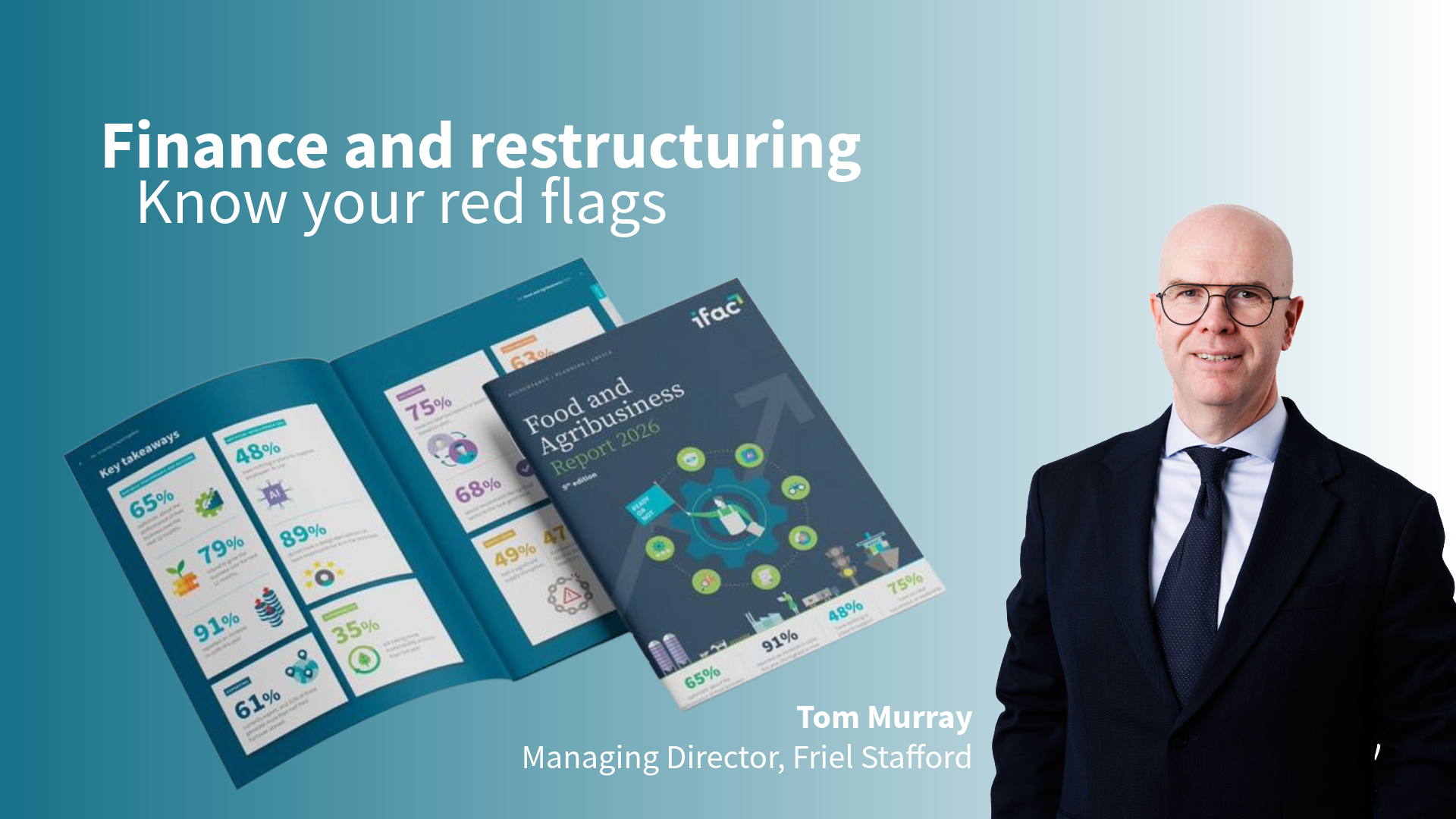
A contribution from Tom Murray, Partner at Friel Stafford, to the ifac Food & Agribusiness Report 2026
Know your red flags
By the time a business owner calls us at Friel Stafford, they usually already know something is wrong.
Cash is getting tighter, the overdraft is no longer clearing as it used to, suppliers are looking for money and debtors are taking longer to pay. A customer may have been lost, margins may have slipped, or a part of the business may be underperforming. The mistake is waiting until several of those problems are happening at the same time.
Three quarters of food and agribusinesses in this year’s survey reported at least one indicator of financial distress, while only one in four reported none. One warning sign on its own does not mean a business is in serious trouble, but when two or three start appearing together it is time to understand what is driving them.
Firefighting, which is the most common red flag this year (25%) is often what happens before the cash problem becomes obvious, as the owner spends the week dealing with whatever is most urgent and the bigger decisions on pricing, costs, debtors, funding or an underperforming part of the business keeps being pushed back.
Stock is another warning sign worth watching. Some 22% reported rising stock levels or slower stock turnover. It may appear as an asset in the accounts, but it still has to be funded and if stock continues to build while sales slow, the pressure on working capital can become serious very quickly. From a restructuring point of view, the important question is what happens when these warning signs are allowed to build.
Stage 1: you still have choices The first signs are often relatively ordinary with trade slowing or margin falling. Sometimes the owner starts reducing or stopping their own wages so that staff and suppliers can still be paid, which is understandable but should also be treated as a very serious warning sign. At this point, the problem may still be largely invisible outside the business and there is usually still room to act. Management can look properly at the numbers, identify where the pressure is coming from and decide what needs to change before others start making those decisions for them.
Stage 2: others start to notice The next stage is when the problem begins to show outside the business. Tax payments slip, suppliers are asked for more time, rent or loan repayments are delayed and accounts may be late. Credit terms tighten, the bank starts asking more questions and suppliers who were previously patient become less willing to wait. Banks, Revenue and suppliers will generally engage when management comes to them early understands the numbers and can set out a sensible plan. The conversation becomes much more difficult once commitments have been missed repeatedly and confidence starts to go.
Stage 3: control starts to move away from you By the third stage, the options have narrowed considerably. Suppliers may demand payment or seek to recover stock, the bank may refuse additional funding and businesses can end up using expensive short-term lenders because more conventional options are no longer available. Solicitors’ letters may arrive, Revenue arrears can increase and finding the money for wages becomes a weekly problem. At that point, decisions are increasingly being driven by creditors and by whatever cash is available that day.
What makes a business recoverable?
Not every business in difficulty can be saved and sometimes the underlying business is simply no longer viable. The businesses that have the best chance usually still have a sound core, a management team prepared to act and a problem that can be clearly identified and dealt with. Just as importantly, they still have enough time and cash to make changes, and the bank, Revenue and key suppliers have not lost confidence completely.
That is why timing matters so much. If you go to the bank early with up-to-date numbers, a cashflow forecast and a realistic plan, there is something to discuss. The same applies to Revenue and major suppliers. Leave it another six or nine months and the underlying business may not have changed dramatically, but the options available to you often have.
There are good restructuring tools available, including refinancing, informal creditor arrangements, SCARP and examinership, but they all work better when there is still enough time to use them properly.
If the overdraft is constantly at its limit, debtors are stretching, stock is building, Revenue is falling behind or too much of the week is being spent firefighting, do not wait for another warning sign. Get the numbers in front of you, work out where the pressure is coming from and what the next six to twelve months are likely to look like and make the call while the choices are still yours.
If this article raises questions for you and your business, please reach out to our Team at Friel Stafford for advice and assistance.